ONLINE PSYCHOEDUCATIONAL GROUP FOR HIGH-ACHIEVING, BUSY-BRAINED WOMEN
You don't need to become more certain. You need to stop needing certainty before you can move forward.
Permission to Be Uncertain™


A 12-session online psychoeducational group for women exhausted by overthinking, second-guessing, and trying to get everything “right.”
Choose Your Weekly Group: Thursdays at 7:00 AM MST or Sundays at 2:00 PM MST | Continuous Enrollment | $45/session | $540 total | Payment Plans Available | Limited to 7 Participants | Colorado Educator CEUs Available | Online

Your Brain Is Very Good at Finding the Next “What If?”
You probably aren't lacking insight. You may understand exactly what you're doing. You know you're overthinking. You know you can't predict every outcome. You know reassurance only helps temporarily. You may have read the books, saved the posts, journaled about it, and told yourself approximately 4,000 times to just stop worrying about it.
And yet...
When something actually matters, your brain wants certainty.
So you analyze a little longer.
Check one more time.
Run through one more scenario.
Ask one more person.
Wait until you feel sure.
Except “sure” keeps moving. The more important the decision, relationship, conversation, or outcome feels, the harder your mind works to eliminate uncertainty.
And that effort can quietly take over an enormous amount of your life
It's that your brain has learned to treat uncertainty like a problem that has to be solved.
The Problem Isn't That You Think Too Much.


Overthinking can feel productive because technically, you're doing something.
You're analyzing.
Preparing.
Problem-solving.
Trying to prevent regret, disappointment, embarrassment, conflict, failure, or the possibility of getting something wrong.
Sometimes that thinking is genuinely useful.
But sometimes you're no longer solving the problem.
You're trying to solve the feeling of not knowing.
And that's an impossible job. Because life keeps producing uncertainty.
Relationships are uncertain.
Other people's reactions are uncertain.
Careers are uncertain.
Health is uncertain.
Parenting is uncertain.
Decisions are uncertain.
The future is exceptionally inconsiderate about refusing to provide guarantees.So what if the goal wasn't finally figuring out how to feel certain?
What if you learned how to move forward even when part of you still isn't sure?
Permission to Be Uncertain™ Was Built for That.
Permission to Be Uncertain™ is a 12-session, continuously enrolling psychoeducational group for high-achieving, busy-brained women who are tired of losing so much time and energy to overthinking, second-guessing, certainty-seeking, perfectionism, and trying to make the “right” choice.
This isn't a group about becoming careless, ignoring your instincts, or making impulsive decisions. And we're not going to teach you how to magically stop having anxious or uncertain thoughts.
Instead, you'll learn a repeatable framework for noticing when your mind has become hooked by uncertainty, experimenting with a different response, and learning from what happens when you try.
Grounded in Acceptance and Commitment Therapy (ACT) and The Red Door's Discover → Grow → Integrate™ framework, the group helps you build psychological flexibility: the ability to make room for uncomfortable thoughts and feelings, get less tangled in what your mind is telling you, reconnect with what matters, and choose how you want to respond.
Through practice, structured reflection, feedback, and adjustment, you'll have repeated opportunities to apply those skills to whatever uncertainty is actually showing up in your life right now, rather than waiting until you finally feel completely sure before moving forward.
Because confidence doesn't always come before the decision. Sometimes confidence grows from discovering:
I can feel uncertain and still trust myself enough to take the next step.

Permission to Be Uncertain may resonate if you:
→You can turn a relatively ordinary decision into an internal Supreme Court hearing.
→You replay conversations and wonder whether you said too much, too little, sounded weird, offended someone, or missed something important.
→You ask people you trust for reassurance but notice the relief doesn't last very long.
→You spend enormous amounts of energy researching, preparing, checking, comparing, or trying to anticipate every possible outcome.
→You avoid decisions because choosing one thing means giving up the certainty that another option might have been better.
→You struggle to trust your judgment unless someone else validates it.
→You feel responsible for preventing disappointment, mistakes, conflict, or negative outcomes.
→You sometimes know exactly what you want—and still can't quite give yourself permission to choose it.
And perhaps most frustratingly:
→You know you're doing this while you're doing it. You just haven't figured out how to stop getting pulled back into the loop.
You Don't Need Another Person Telling You to “Stop Overthinking.”
The goal isn't to win every argument with your brain.
It's to become less dependent on winning the argument before you can live your life.
You need opportunities to practice what to do when your mind starts overthinking. That's an important distinction.
Permission to Be Uncertain™ isn't designed around giving you 12 weeks of information about why humans worry.
It's designed around practice.
Across the 12 sessions, we'll use the six core processes of ACT as a framework for experimenting with different ways of responding to uncertainty.
You'll practice noticing thoughts without automatically obeying them.
Making room for discomfort without immediately trying to make it disappear.
Returning to the present when your brain races ten steps into the future.
Recognizing the stories and rules that keep pulling you back into analysis.
Clarifying what actually matters when there isn't a perfectly safe option.
And taking meaningful action without waiting for your mind to issue a 100% certainty guarantee.
Why 12 Weeks?
Because understanding something once and being able to use it when you're stressed are two very different things.
Permission to Be Uncertain™ isn't designed around completing 12 lessons in the “right” order. It's designed around having enough consistency to learn a framework, practice it in real life, get feedback on what happens, adjust, and try again.
That's why enrollment is a 12-session commitment. Throughout your 12 sessions, we'll continually return to the six core processes of Acceptance and Commitment Therapy (ACT), not as concepts you're expected to master one by one, but as a repeatable framework for working with whatever uncertainty, overthinking, perfectionism, or second-guessing is showing up in your life.
The ACT framework stays consistent. What you're practicing it with keeps changing. One week, you may be caught in an impossible decision. Another, you may notice yourself researching for the fifteenth time, asking someone else what they think, replaying a conversation, avoiding something because you can't guarantee the outcome, or trying desperately to make the “perfect” choice.
Each situation becomes an opportunity to use the Discover → Grow → Integrate™ process:
Discover what's happening, what matters, and where you're getting hooked.
Grow by choosing a realistic, values-connected action and experimenting with a different response.
Integrate by reflecting on what actually happened, learning from your own experience and feedback from the group, and deciding what you want to adjust for your next attempt.
Then you do it again.
That's also why there isn't a Week One you have to catch. Permission to Be Uncertain™ uses continuous enrollment, so you can join whenever one of the group's seven seats becomes available.
The foundational ACT and DGI resources remain consistent, while secondary readings, prompts, discussions, and complementary materials may change throughout the year. That allows the group to keep exploring uncertainty from different angles while everyone continues practicing the same underlying framework.
Your 12 consecutive scheduled sessions give you a sustained period of practice without requiring everyone in the group to begin and end at the same time. And when your 12 sessions are complete, the goal isn't to have “mastered” ACT or eliminated uncertainty. It's to have a framework you know how to return to when your busy brain inevitably gets busy again.
And if another cycle of practice, reflection, feedback, and community would be useful, you may choose to enroll for another 12-session commitment, depending on fit and availability. Because the goal was never to become certain.
It's learning that you can be uncertain—and still know how you want to move forward.
A FRAMEWORK YOU CAN KEEP COMING BACK TO
What We’ll Practice Together.
Over the course of the group, you'll have opportunities to practice:
-
Learning to recognize when your mind is offering a thought rather than automatically treating that thought as a fact, warning, command, or problem requiring immediate resolution.
-
Practicing staying present with discomfort instead of automatically checking, researching, analyzing, avoiding, or seeking reassurance to make it disappear.
-
Noticing when your mind has launched into hypothetical futures, imagined conversations, or post-game analysis—and learning how to return to the life that's happening now.
-
Creating some distance from rigid stories like I have to get this right, I should know better, I can't disappoint anyone, or If I make the wrong decision, I won't be able to handle it.
-
Learning to make decisions based on your values rather than allowing fear, guilt, perfectionism, or the pursuit of certainty to make every decision for you.
-
Practicing small, intentional choices without requiring yourself to feel perfectly confident first.
Because overthinking gets remarkably convincing when you're alone inside your own head.
Why a Group?

There is something powerful about sitting alongside other thoughtful, capable women and realizing:
Oh. Your brain does this too.
Permission to Be Uncertain™ gives you a structured place to learn, experiment, reflect, and practice alongside women who understand what it's like to have a mind that's always working.
You don't have to arrive with something profound to share. You don't have to perform vulnerability. You don't have to be the “good group member.” And you definitely don't have to figure out the right way to do a group about getting things right.
You can show up as you are.
The group provides structure, psychoeducation, guided practice, reflection, and connection while giving you opportunities to notice how these patterns show up in actual life between meetings.
What Permission to Be Uncertain™ Is — And Isn't
This is a focused psychoeducational group, not a substitute for individual psychotherapy or crisis care.
We use evidence-based psychological concepts and experiential practices to help participants better understand patterns and develop practical skills they can experiment with in everyday life.
You will never be expected to disclose something simply because you're in a group.There is no prize for being the most vulnerable person in the Zoom room.And this isn't another place where you need to prove you're “doing the work” correctly.
Come curious. Practice imperfectly. Notice what happens.
That's enough.
-
The group provides psychoeducation, structured reflection, experiential exercises, and opportunities for discussion related to uncertainty and the ways people may respond to it.
Participation does not establish an individual therapist-client relationship with Emily and is not a substitute for individualized assessment, diagnosis, psychotherapy, or other mental health treatment when those services are needed.
Participants experiencing concerns that require individualized clinical care may be encouraged to seek appropriate therapeutic or other professional support.
This is for educational purposes and is not a replacement for individualized mental health care.
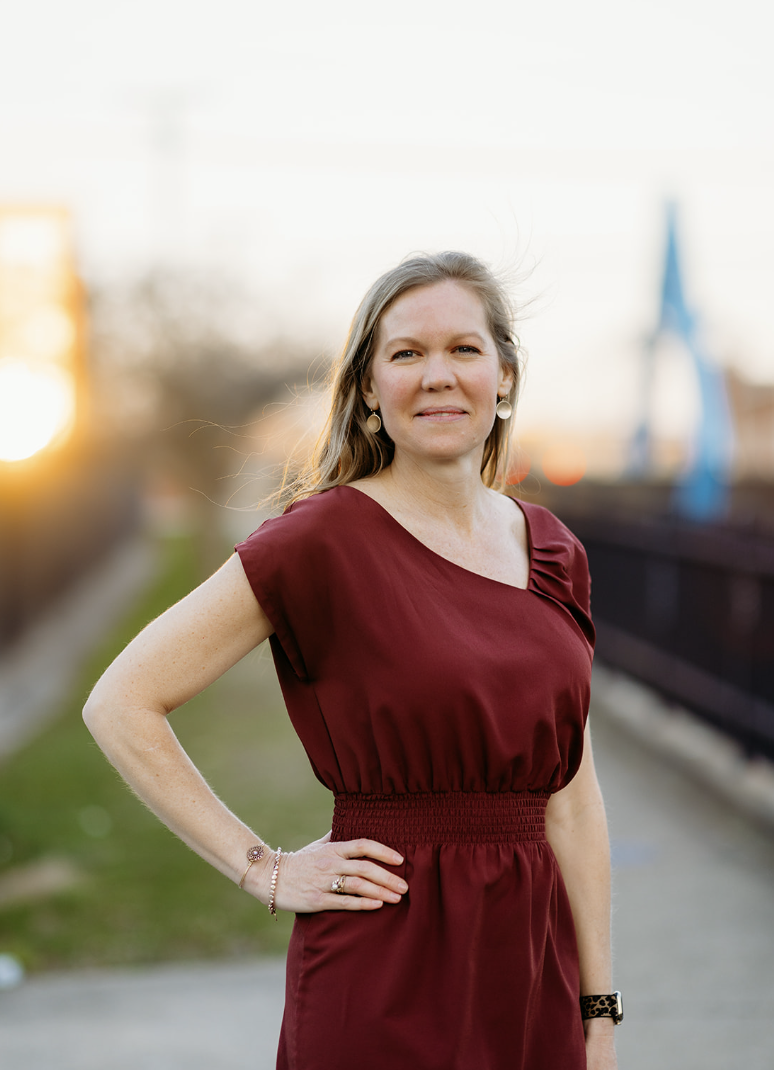
Meet Emily
Therapist. Educator. Fellow Appreciator of a Brain That Likes to Make Things Complicated.
I'm Emily MacNiven, LPC, founder of The Red Door Therapy & Wellness Solutions. My work focuses on high-achieving, busy-brained, people-pleasing women who are incredibly capable and often exhausted by how hard their minds work to anticipate, analyze, manage, and get things right.
Before becoming a therapist, I spent years as an educator and school leader. That background still deeply shapes how I create groups. I don't believe meaningful learning happens because someone gives you more information.
We need opportunities to understand something, experience it, practice it, reflect on what happened when we applied it, and return to it again.
That's one of the reasons ACT is central to my work.
ACT gives us a practical, repeatable framework for navigating difficult thoughts, emotions, uncertainty, and real-life decisions without requiring us to get rid of discomfort before we can move toward what matters.
And yes, we call it ACT, like the verb.
Because eventually, we have to get out of the internal committee meeting and back into our lives.
Learn more about Emily and The Red Door Therapy & Wellness Solutions!
What Joining Looks Like
A Small Group. A Clear Structure. Enough Time to Actually Practice.
What Your Enrollment Includes
-
Permission to Be Uncertain™ is offered at two weekly times:
Thursdays | 7:00–8:00 AM MST
Sundays | 2:00–3:00 PM MSTChoose the group time that works best for you. You’ll attend that same weekly group for your 12-session commitment, giving you consistency without having to wait for a new cohort to begin.
-
Your enrollment reserves one of seven seats for your next 12 scheduled group meetings. Planned Red Door closures do not count toward your 12 sessions.
-
Keeping the group intentionally small allows for conversation, connection, and meaningful practice together.
-
You'll receive a Red Door Reflection Guide designed to help you notice what you're learning, connect group concepts to your real life, and reflect on what you're practicing between sessions.
-
Permission to Be Uncertain™ uses a combination of consistent foundational resources and rotating complementary materials to support your learning throughout your 12-session commitment.
Your foundational materials include ACT-based resources and The Red Door Reflection Guide, which gives you a repeatable way to work through the Discover → Grow → Integrate™ process: noticing what's happening, connecting with what matters, experimenting with a different response, reflecting on what happened, learning from feedback, and deciding what you want to adjust next.
The foundation stays consistent. The material we apply it to can change.
Throughout the year, we may also use selected books, readings, exercises, prompts, and other resources that help us explore uncertainty, perfectionism, overthinking, control, and self-trust from different angles.
Current featured resources may include:
The Perfectionist’s Guide to Losing Control: A Path to Peace and Power
by Katherine Morgan SchaflerThis gives us a highly relatable lens for exploring perfectionism, control, achievement, self-expectations, and the pressure to get things “right.”
Selected concepts and exercises can support our ACT-based exploration of uncertainty, getting hooked by thoughts, willingness, and practicing different ways of responding to uncomfortable internal experiences.
Because Permission to Be Uncertain™ uses continuous enrollment, you don't need to finish a book before joining or catch up on everything the group has already covered. You'll receive information about the materials currently being used when you enroll and can begin with the group from there.
Secondary resources may change seasonally, which also means participants who choose to continue for another 12-session commitment may encounter new material while continuing to practice the same underlying ACT + DGI framework.
Books and other optional external resources are purchased separately and are not included in the $540 group investment.
Some recommended book links may be affiliate links, which means The Red Door may receive a small commission at no additional cost to you.
Do I need to have OCD to participate?
No. Permission to Be Uncertain™ is not an OCD treatment group, and you do not need an OCD diagnosis to participate.
We may use selected material from The ACT Workbook for OCD because its ACT-based exploration of uncertainty, getting hooked by thoughts, willingness, and responding differently to difficult internal experiences overlaps with skills that can be useful when working with overthinking, perfectionism, and certainty-seeking more broadly.
The group is psychoeducational and is not intended to provide specialized assessment or treatment for OCD.
-
$45 per session | $540 total commitment | Payment plans available
At the end of your 12 sessions, you can choose to complete your participation or enroll for another 12-session cycle, depending on fit and availability.
Because your registration reserves one of only seven spaces in this intentionally small group, payment is for your reserved place in the full enrollment window. Refunds or credits are not provided for sessions you are unable to attend.
-
Each 60-minute session is followed by an optional 15 minutes to stay, connect with other participants, or check in with Emily.
-
Join a free onboarding before you begin to meet Emily, ask questions, and get oriented to the experience.
-
Participation is eligible for CEUs for Colorado educators, subject to the applicable participation/completion requirements.
You May Never Get the Certainty Your Brain Keeps Asking For.
But you can build something much more useful: the ability to trust yourself while uncertainty is still there.

Imagine making a decision and allowing it to be made.
Having a difficult conversation without spending the next three hours conducting a forensic analysis of everyone's facial expressions.
Not needing five people's approval before trusting what you already know matters to you.
Catching yourself entering an overthinking loop and recognizing: Oh. I know this place.
And having something to do besides thinking harder. Not because uncertainty suddenly feels wonderful. Not because your brain stops producing what-ifs. But because uncertainty no longer gets to make every decision about how you live.
For Colorado Educators
Professional Development That Supports the Professional, Too.
Permission to Be Uncertain™ is eligible for Continuing Education Units (CEUs) for Colorado educators.
Because professional growth doesn't have to be completely separate from learning how to navigate uncertainty, stress, decision-making, psychological flexibility, and the internal pressure that follows you through the workday.
-
Colorado Educators: Earn Professional Development Hours
If you're a Colorado educator, your participation may also support your professional license renewal.
Upon completion of this program, The Red Door Therapy & Wellness Solutions will provide a certificate documenting your completed professional development contact hours. Your certificate will include the program name, dates of participation, number of contact hours completed, and verification of completion.
The Colorado Department of Education (CDE) allows educators to use qualifying ongoing professional development and training toward the 90 clock hours required for license renewal. CDE does not pre-approve individual professional development providers or programs. Educators are responsible for determining how a professional development experience applies to their license, endorsement area, professional practice, and applicable educator standards.
This program offers up to [XX] professional development contact hours for Colorado educators who complete the full program.
Professional development hours are based on documented participation. Acceptance toward Colorado educator license renewal is determined by CDE based on the individual educator's license and the applicability of the professional development completed.
-
Educators make hundreds of decisions in environments where the answers aren't always clear. They navigate competing priorities, changing expectations, difficult conversations, student needs, family concerns, and the pressure to somehow get it all right.
Permission to Be Uncertain develops skills educators can apply directly to their professional practice, including psychological flexibility, values-based decision-making, responding effectively to difficult thoughts and emotions, tolerating uncertainty, and staying engaged with what matters even when discomfort is present.
These skills can support educators in navigating workplace stress, responding more flexibly to challenging situations, communicating and making decisions with greater intention, and sustaining their effectiveness in demanding educational environments.

Permission to Be Uncertain™
12 sessions. Seven women. One practical framework for learning to live without requiring certainty first.
You Don't Have to Figure This Out Before You Join.
If you've been waiting until you're sure this is the right group, sure you're ready, sure you'll have enough time, sure you'll fit in, or sure it will be worth it... Well. We may have found our first opportunity to practice.