
I’ve spent more than 20 years working alongside people who care deeply, carry enormous responsibility, and are often the last ones to admit just how much it is costing them.
Before becoming a therapist, I was a teacher, school counselor, and principal. I know environments where the work matters, people depend on you, there is always something else that needs your attention, and slowing down can feel almost irresponsible.
I understand the people who are really good at holding it all together.
MEET EMILY MACNIVEN, LPC

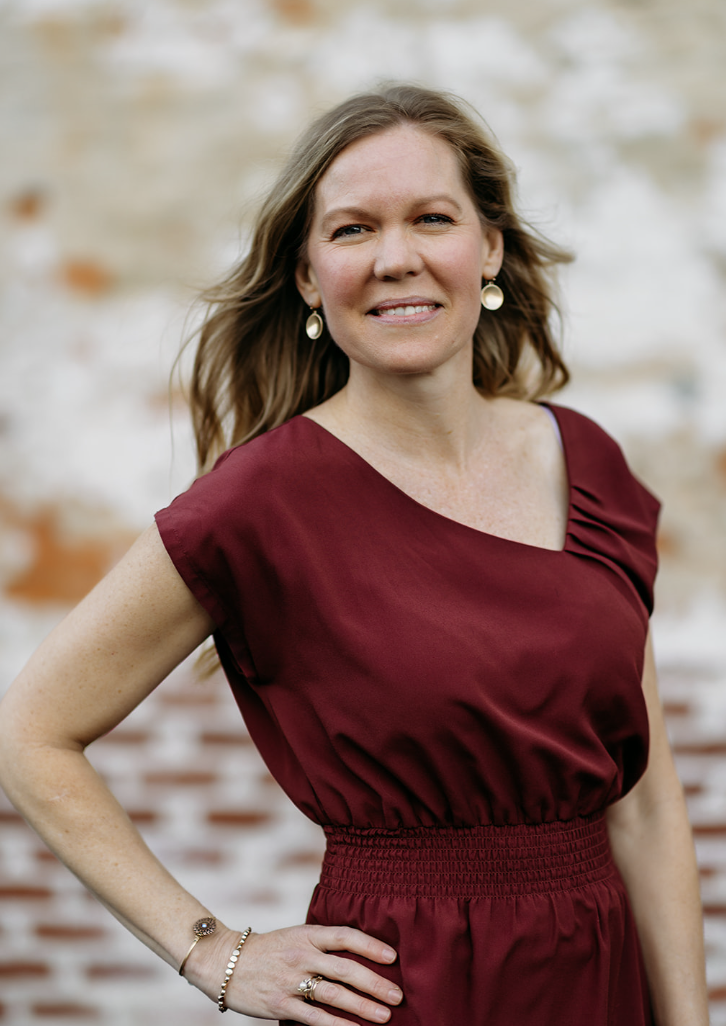
Today, I work with high-achieving, busy-brained women who are tired of being incredibly capable at the expense of themselves.
And no, my goal isn't to make you even better at handling an unreasonable amount of things.

Please hear me when I say:
You don't need another person telling you what you “should” be doing.
Chances are, you already know quite a bit about yourself. You know you overthink. You know you're carrying too much. You know you should probably say no more often, stop checking email at night, take an actual lunch break, ask for help before you're drowning, and quit treating rest like something you have to earn.
Knowing isn't necessarily the problem. Doing something different when your brain is loud, someone is disappointed, work is demanding, or the stakes feel high? That's harder.
That's the work I'm interested in.
I help women become more psychologically flexible, not by eliminating difficult thoughts, feelings, uncertainty, or stress, but by learning how to make room for those experiences without automatically letting them decide what happens next.
Sometimes that work happens in individual therapy. Sometimes it happens through one of The Red Door's Signature Groups. And sometimes a small practice embedded into an ordinary Tuesday is exactly where change starts becoming real.
How I work
Warm, practical, evidence-based—and occasionally willing to call your busy brain on its nonsense.
Therapy with me isn't about sitting quietly while I nod thoughtfully and ask, “And how does that make you feel?” for 50 minutes.
We will absolutely make room for feelings. We'll also get curious about patterns, notice what your mind is doing, talk about what matters to you, laugh when appropriate, practice things, experiment, and figure out what any of this looks like when you leave the therapy room and return to your actual life.
My work is grounded primarily in Acceptance and Commitment Therapy (ACT), an evidence-based approach focused on psychological flexibility. Rather than trying to eliminate every uncomfortable thought or feeling, we'll work on changing your relationship with those experiences so you have more freedom to choose how you want to respond.
I won't expect you to become perfectly regulated, endlessly mindful, or magically unbothered by difficult things.
We're going for more flexible, more intentional, and more able to come back to yourself when life inevitably gets messy.
Therapy with me is…
Approachable
You don't have to speak fluent therapy. Come as you are, say the thing awkwardly, change your mind, swear if that's your thing, and ask questions.
Authentic
I'm a real human in the room with you. I bring warmth, curiosity, humor, and genuine engagement to our work rather than hiding behind clinical jargon.
Supportive + Honest
I'll make room for how hard something is and help you notice when an old pattern is quietly running the meeting.
Collaborative + Flexible
You're the expert on your life. We'll work together to understand what matters, experiment with what helps, and adjust when something isn't working.

MY PATH HERE
Before I was a therapist, I spent years inside the kinds of systems my clients are trying to survive.
I've spent more than two decades in helping professions, as a teacher, school counselor, principal, and therapist. Those roles gave me a front-row seat to what happens when deeply caring, highly capable people work inside environments where the needs are endless, and the resources rarely are.
I saw people become extraordinarily good at functioning under pressure. I also saw how easily dedication could become overfunctioning, responsibility could become self-abandonment, and “I'm fine” could coexist with profound exhaustion. That experience still shapes how I work today.
I'm interested not only in what's happening inside a person, but also in the systems, expectations, relationships, roles, and demands surrounding them. Because sometimes the answer isn't learning how to cope better with an impossible load.
Sometimes we need to question the load.
Why This Matters to Me
I built The Red Door because I saw too many brilliant, capable people succeeding externally while quietly losing themselves underneath the pressure of chronic striving and overfunctioning.
And I understand some of that experience personally, too.
I know what it's like to have a mind that races toward the next outcome and to discover how easy it is to become so focused on managing, achieving, anticipating, and getting things right that you stop fully inhabiting the life all that effort was supposed to be for.
That is part of why this work matters so deeply to me. I don't believe high-achieving women need another person handing them a list of things they should be doing better. And I don't believe wellness should become another performance metric.
I want to create spaces where people can slow things down enough to notice what's happening, reconnect with what matters, practice responding differently, and carry those shifts back into their actual lives.
My hope for The Red Door is bigger than helping people feel less stressed. I want the work we do here to help people live with more flexibility, vitality, connection, meaning, and presence, and for those changes to ripple outward into their relationships, families, workplaces, and communities.
My Training
& Education
-
PhD Student, Counseling & Supervision, University of the Cumberlands
Master of Education, Educational Leadership & Policy Studies, The University of Texas Arlington
Master of Arts, School Counseling, The University of Northern Colorado
Bachelor of Arts, Elementary Education/Bilingual-Bicultural Education & Spanish, The University of Northern Colorado
-
CO Licensed Professional Counselor (LPC) LPC.0019496
CO Licensed School Counselor
(LSC) 24418278
-
Advanced training in Acceptance & Commitment Therapy (ACT)
Advanced training in Cognitive Behavioral Therapy (CBT)
Advanced training in Mindfulness & Stress Management Techniques
Advanced training in Career Counseling
Advanced training in Internal Family Systems Therapy
Motivational Interviewing Certification
Solution-Focused Brief Therapy Certification

You don't have to become a different person to build a different relationship with your life.
I genuinely like working with smart, caring, complicated humans whose brains have seventeen tabs open. You can bring the overthinking. The ambition. The sensitivity. The weird sense of humor. The part of you that desperately wants things to change and the part that is deeply suspicious of changing anything. We don't need to get rid of the parts of you that made you capable. We can work on helping those parts stop having to run the whole show.